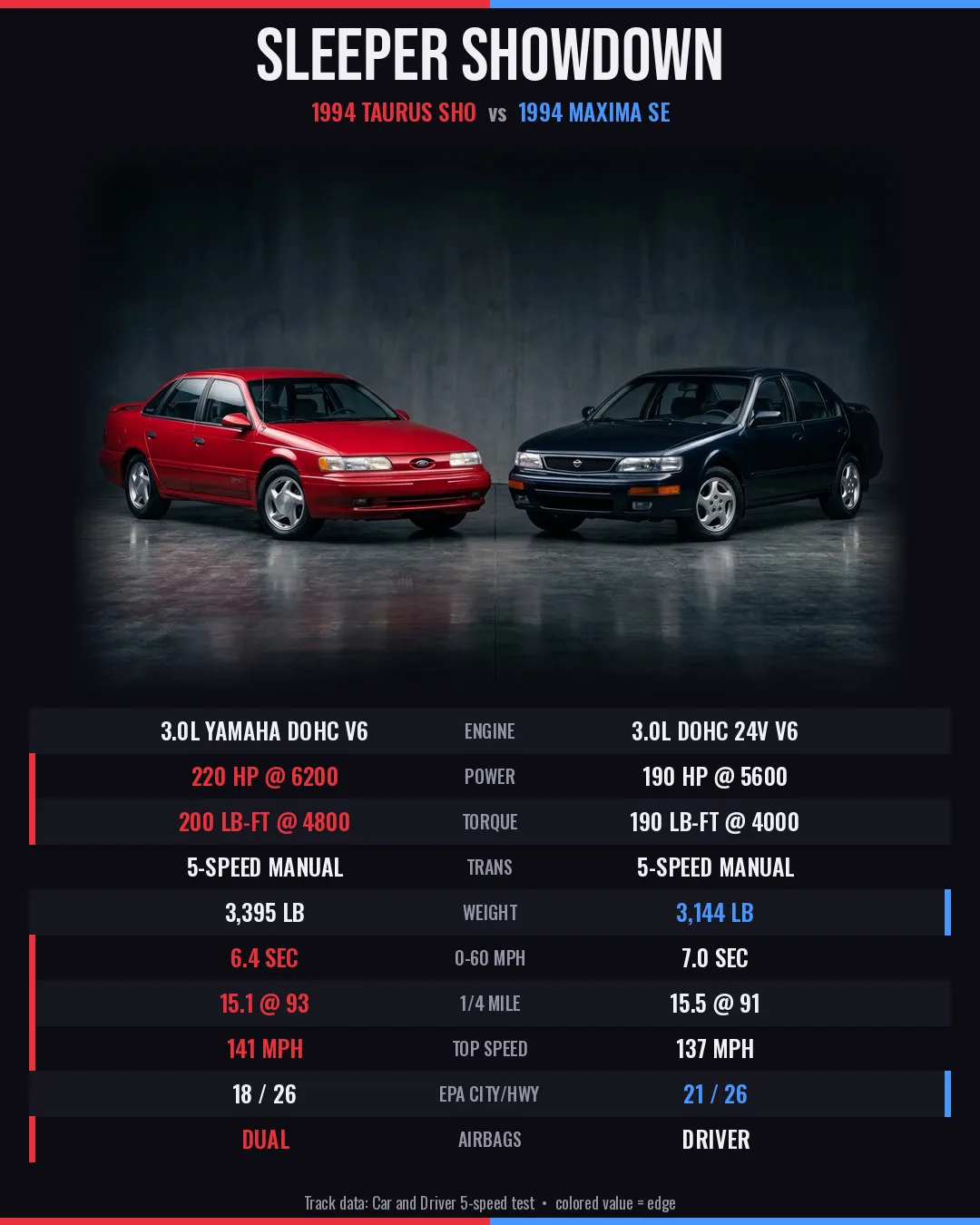
Sleeper Showdown: 1994 Ford Taurus SHO vs 1994 Nissan Maxima SE
Personal opinion. I've been buying used cars for 30 years, and the 90s are my era.
On my walk home from school in the 90s, I passed a house with a beautiful silver SHO sitting in the driveway. I'd drool over that car every day. I'd dream about driving it around with my friends on a nice summer New England day, maybe a cute girl in the passenger seat, rowing through the gears and hearing that Yamaha V6 growl.
As a teenager I worked at car dealerships, so I got to drive these very cars. The Maximas always felt tighter and better built. The SHOs looked better (a sexy sedan) and felt a little bigger and more spacious inside.
In 1994 you could walk into a showroom and leave in a family sedan with a DOHC 24-valve V6 and a stick shift. Two of the best were the Ford Taurus SHO, with its Yamaha engine, and the Nissan Maxima SE, the "4DSC" (four-door sports car). Here's how they stack up on paper, both with the 5-speed manual.
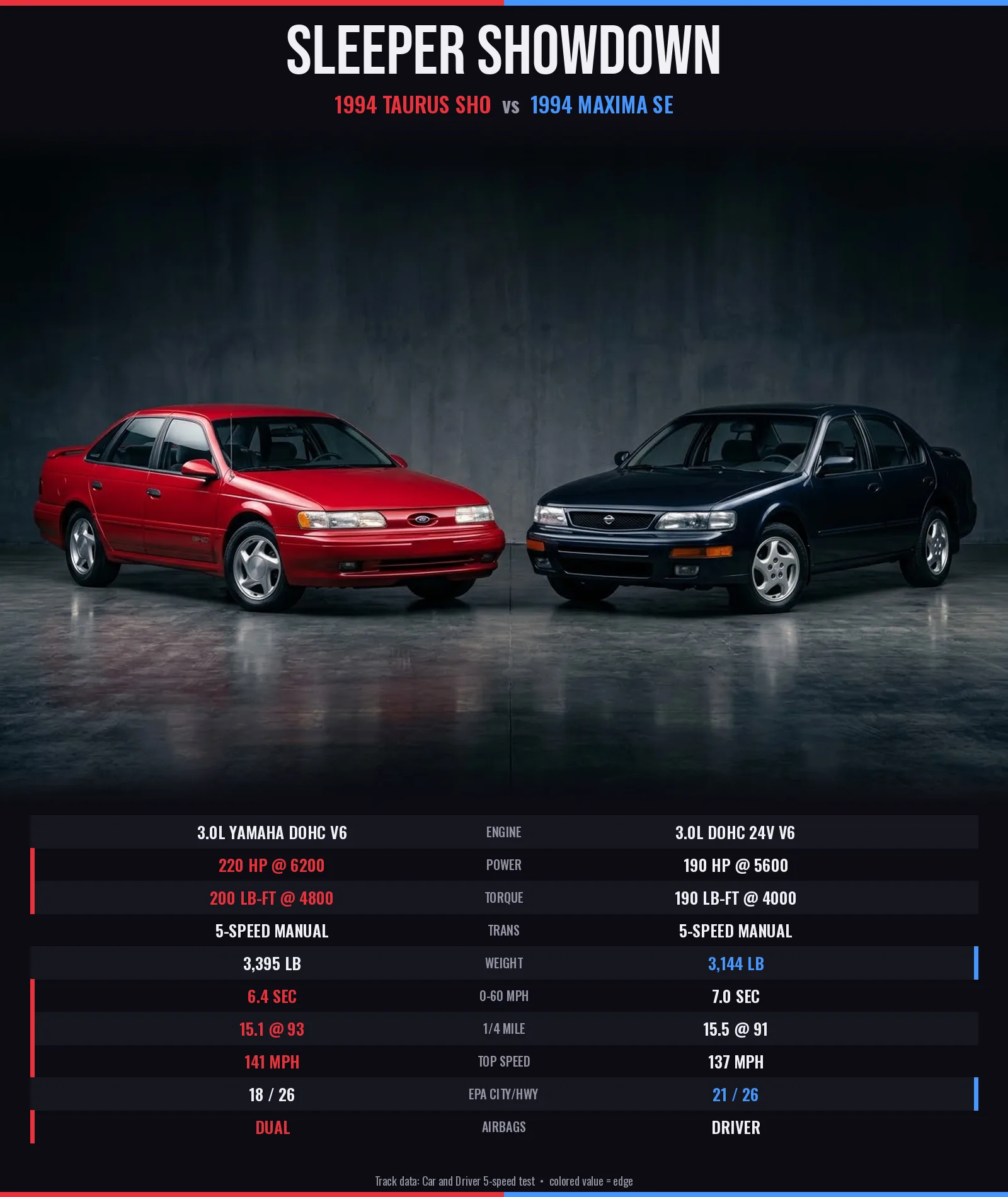
The numbers
| Spec | 1994 Maxima SE 5MT | 1994 Taurus SHO 5MT |
|---|---|---|
| Engine | 3.0 VE30DE DOHC 24v V6, variable intake valve timing | 3.0 Yamaha DOHC 24v V6 |
| Power | 190 hp @ 5600 | 220 hp @ 6200 |
| Torque | 190 lb-ft @ 4000 | 200 lb-ft @ 4800 |
| Transmission | 5-speed manual, FWD, viscous limited-slip | 5-speed manual (Mazda-designed), FWD |
| Curb weight | 3,144 lb | 3,395 lb |
| 0–60 | 7.0 s | 6.4 s |
| 1/4 mile | 15.5 s @ 91 mph | 15.1 s @ 93 mph |
| Top speed | 137 mph | 141 mph |
| EPA city/hwy (original) | 21/26 | 18/26 |
| Airbags | Driver | Dual (passenger bag new for '94) |
The track numbers come from Car and Driver's August 1992 comparison, where both cars had 5-speeds. The powertrains didn't really change through 1994, but the '94 SHO picked up a little weight from the passenger airbag. Treat its figures as close, not exact. Other tests put the SHO's 0–60 slower, around 7.6 seconds.
What sets them apart
- Taurus SHO: Yamaha V6 with a 7,000-rpm redline, a 140-mph speedometer, four-wheel discs, ground effects and 16-inch alloys. One catch: in 1994 only the 3.0 came with the manual. The 3.2 was automatic-only.
- Maxima SE: "4DSC" decals on the rear window, white-face gauges, twisted-spoke turbine alloys, rear discs, twin-tip exhaust, and a viscous limited-slip differential.
On paper the SHO wins on power and speed, and the Maxima wins on weight and fuel economy.
If I were buying one today, I'd take the Maxima. In my opinion it's likely to be a lot more reliable. The SHO engine is known for its reliability issues, and I think that's why clean Maximas are easier to find today.
Buying one today
On either car, the first thing I do is pull the oil cap. If you see sludge that looks like peanut butter, or water in the oil, walk away. Next, grab a flashlight and check for leaks from the top of the engine all the way to the bottom. Even better, get it up on a lift. For a clean example, I'd personally pay $8,000–10,000. That's my opinion of what one is worth to me, not market data.
My verdict
So nostalgic. But I know that today the SHO would probably lead to heartbreak and frustration, so I'll go with the Maxima.
Sources
- Car and Driver, 8/92 comparison: https://www.caranddriver.com/reviews/a73836326/1992-ford-taurus-sho-vs-nissan-maxima-vs-toyota-camry-archive-comparison-test/
- Maxima specs: https://www.kbb.com/nissan/maxima/1994/se-sedan-4d/ · https://www.autodetective.com/directory/1994/nissan/maxima/trim/se/ · https://en.wikipedia.org/wiki/Nissan_Maxima
- SHO specs: https://www.carfolio.com/ford-taurus-sho-774961 · https://www.automobile-catalog.com/performance/1994/880850/ford_taurus_sho.html · https://www.edmunds.com/ford/taurus/1994/review/ · https://en.wikipedia.org/wiki/Ford_Taurus_SHO
- Deseret News, 3/93 SHO review: https://www.deseret.com/1993/3/5/19035422/want-a-sports-car-don-t-ignore-taurus-sho-but-ask-for-5-speed/
For X / Instagram: portrait card (1080×1350)